Rescreen or Replace? How to Tell If Your Pool Cage Is Worth Saving
J-Rod and Sons Screen Rooms — family-owned screen room builders in Greater Jacksonville. 15 years in the trade, 300+ enclosures, and a 10-year workmanship warranty on every build.
The short version
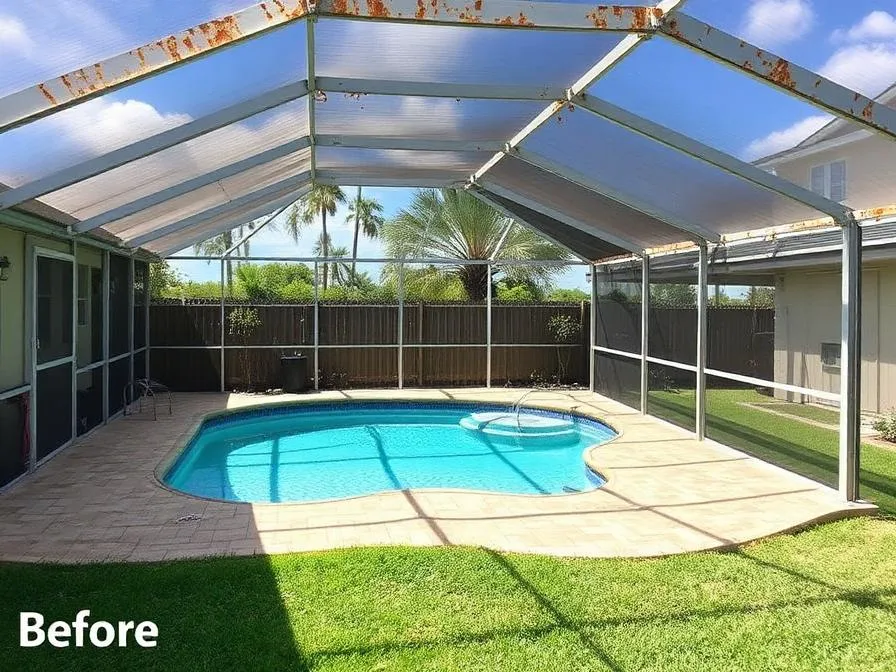
If the aluminum frame is straight, solid, and still anchored, you need a rescreen — not a new cage. Screen is the part that fails first in Florida; the frame usually outlives several sets of it. Replace the structure only when the frame is corroded through, bent from a storm, or pulling away from its footings.
Every week somebody calls us about their pool cage and opens with “I think I need a whole new one.” Most of the time they don't. That is the single most expensive assumption in this trade, and it is usually wrong.
Here is how to tell the difference before anyone quotes you a number.
The 60-second check you can do yourself
Walk the perimeter of the cage and put your hands on it. You are checking the frame, not the screen — the screen is going to look bad either way, and that is not the deciding factor.
- Push on the uprights. Solid and stiff? Good. Flexing, wobbling, or moving at the base is a frame problem.
- Look at the base of each post. Surface staining is normal in Florida. Flaking, bubbling, or metal you can push a screwdriver through is not.
- Sight down the beams. They should run straight. A visible bow or twist usually means it took a hit.
- Check the anchors. If the frame is lifting off the deck or the bolts are weeping rust stains, stop and call somebody.
If the frame passes that, your enclosure is fine. You have a screen problem, and screen problems are cheap compared to structures.
When a rescreen is all you need
Florida sun is what kills screen. UV breaks down the mesh over years until it goes brittle, loses tension, and tears — almost always at the corners and along the bottom panels first. Near the coast, salt speeds it up. None of that touches the structural integrity of the aluminum.
A rescreen is the right call when you are seeing:
- Sagging or “baggy” panels that have lost tension
- Tears at the corners or along the kick plate line
- Screen that has yellowed or gone chalky
- Doors that won't latch (usually hardware or alignment, not the frame)
- A few blown-out panels after a storm, with everything else intact
This is also the cheapest moment to upgrade. Once the old screen is coming out anyway, switching to a tighter no-see-um mesh or pet-resistant screen costs very little extra in labor. If no-see-ums are getting through your current screen, standard mesh will never stop them — the weave is simply too open, and no amount of retensioning changes that.
We cover the full range of this on our screen repair and rescreening page.
When you actually need a rebuild
We will tell you straight when the answer is a new cage. That is:
- Corrosion through the metal. Once a post is compromised, you are not patching your way back. Screen tension pulls against a frame that can no longer take it.
- Bent or twisted framing after a storm. A beam that took a limb can be deformed in ways that look fine from the ground and fail the next time the wind picks up.
- Failed anchors or footings. If the structure is separating from the deck, screen is not your problem.
- An older cage well below current wind standards. Florida's requirements have tightened considerably. The Florida Building Code is stricter than what a lot of standing enclosures were originally built to.
If a storm is what brought you here, our storm damage rebuild page covers how we document damage for insurance. And if the old structure has to come out, we handle tear-outs and haul-away as part of the same job so you are not paying two mobilizations.
What it costs to guess wrong
Guessing wrong runs both directions, and both are expensive.
Replace a perfectly good cage and you have paid for a structure you did not need. Rescreen a frame that is actually failing and you have paid to stretch new mesh across something that is going to move — the screen will pull loose, and you will pay twice.
This is the one opinion we will not soften: most enclosures people write off as a lost cause just need new screen. Fifteen years and 300-plus jobs across Northeast Florida, and the ratio has not really changed. When somebody has already decided they need a full replacement, that is exactly when we slow down and check the frame first.
It is also why every build we do carries a 10-year workmanship warranty. You can only stand behind work for a decade if you were honest about what the job actually needed on day one.
FAQ
Can I just rescreen one panel, or does it all have to be done?
A single panel is fine — we do single-panel repairs all the time. If most of the cage is the same age and starting to go, doing it all at once costs less per panel than coming back four times.
How long does screen last in Jacksonville?
Several years, and less near the coast where salt accelerates the breakdown. The aluminum frame lasts decades. That gap is the entire reason rescreening exists.
Will a rescreen fix my sagging panels?
Yes. Sagging is tension loss, which is a screen condition, not a frame condition — assuming the frame passed the check above.
Do I need a permit to rescreen?
Rescreening an existing structure generally does not require a permit. Building or rebuilding an enclosure does, and we pull it as part of the job across Duval and Clay County.
How do I know you are not just telling me to rebuild?
Fair question, and the honest answer is you should ask any contractor to show you. We will put hands on the frame with you and point at what we are seeing. If it is a rescreen, we will say so — that is the smaller job, and we would rather have the referral. More on how we work on our why choose us page.
Walk the job with the owner.
Tell us what you're thinking. We'll come look, point out what we'd do differently, and only quote what we're confident we can deliver.